rm(list =ls())# delete any data that's already loaded into Rconflicts_prefer(dplyr::filter)ggplot2::theme_set(ggplot2::theme_bw()+# ggplot2::labs(col = "") +ggplot2::theme( legend.position ="bottom", text =ggplot2::element_text(size =12, family ="serif")))knitr::opts_chunk$set(message =FALSE)options('digits'=6)panderOptions("big.mark", ",")pander::panderOptions("table.emphasize.rownames", FALSE)pander::panderOptions("table.split.table", Inf)conflicts_prefer(dplyr::filter)# use the `filter()` function from dplyr() by defaultlegend_text_size=9run_graphs=TRUE
1 Empirical CDF and quantiles
Definition 1 (Empirical CDF) For observed values \(x_1,\ldots,x_n\), the empirical CDF is \[\hat F(t)=\frac{1}{n}\sum_{j=1}^n I(x_j\le t), \quad t\in\mathbb{R}.\] Here \(I(A)\) is the indicator function: \(I(A)=1\) if \(A\) holds, and \(I(A)=0\) otherwise.
Definition 2 (Order statistics) For observed values \(x_1,\ldots,x_n\), the order statistics are the sorted values \[x_{(1)}\le x_{(2)}\le\cdots\le x_{(n)}.\]
Example 1 (Numerical example: order statistics) If the observed values are \(4,1,7,3\), then the order statistics are \(x_{(1)}=1\), \(x_{(2)}=3\), \(x_{(3)}=4\), and \(x_{(4)}=7\).
Definition 3 (Sample quantile) Given empirical CDF\(\hat F\), the sample quantile function (EQF) (the generalized inverse of \(\hat F\)) is \[\hat Q(p)=\inf\{t:\hat F(t)\ge p\}, \quad 0<p\le 1.\]
The CDF\(F\) and quantile function\(Q\) are population-level functions, while \(\hat F\) and \(\hat Q\) are sample-based estimates of them.
Theorem 1 (Order-statistics form of the sample quantile) If \(x_{(1)}\le\cdots\le x_{(n)}\) are the order statistics, then \(\hat Q(p)=x_{(i)}\) for \(p\in((i-1)/n,i/n]\). In particular, \(\hat Q(i/n)=x_{(i)}\).
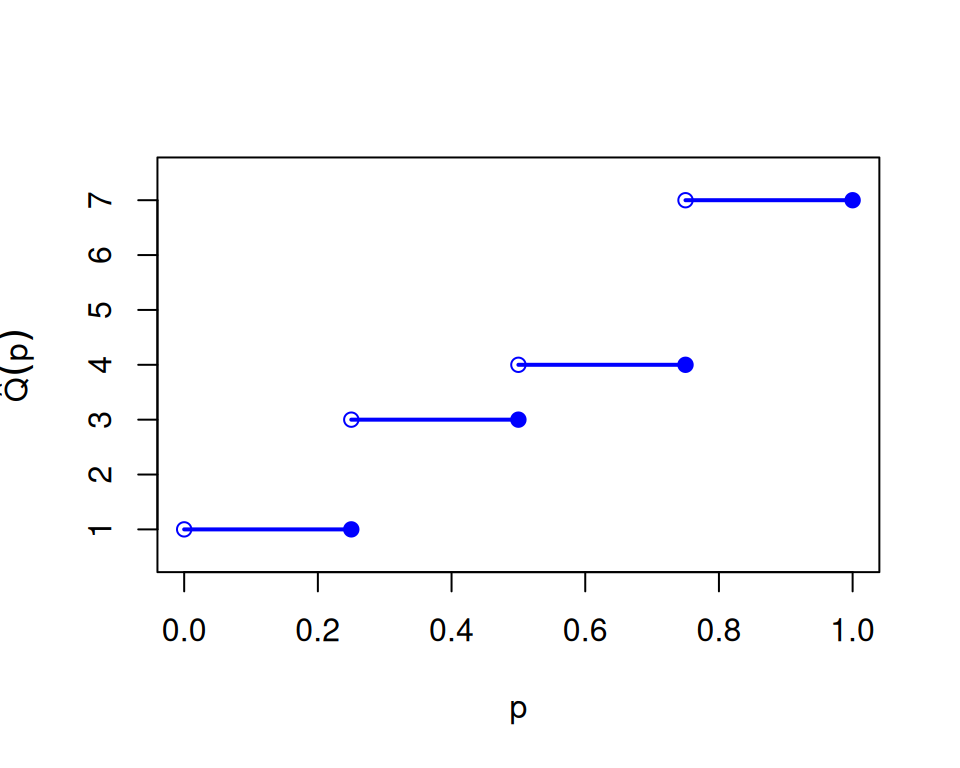
Example 2 (Numerical example: sample quantiles) Using the same data \(4,1,7,3\), with order statistics \(1,3,4,7\), the sample quantile function is stepwise: \(\hat Q(p)=1\) for \(0<p\le 1/4\), \(\hat Q(p)=3\) for \(1/4<p\le 1/2\), \(\hat Q(p)=4\) for \(1/2<p\le 3/4\), and \(\hat Q(p)=7\) for \(3/4<p\le 1\). So \(\hat Q(0.5)=3\) and \(\hat Q(0.9)=7\).
Show R code
x<-c(4, 1, 7, 3)n<-length(x)x_ord<-sort(x)p_ord<-seq_len(n)/necdf_x_padding<-0.8eqf_y_padding<-0.5x_min<-min(x_ord)-ecdf_x_paddingx_max<-max(x_ord)+ecdf_x_paddingx_left<-c(x_min, x_ord)x_right<-c(x_ord, x_max)f_levels<-c(0, p_ord)plot(0,0, type ="n", xlim =c(x_min, x_max), ylim =c(0, 1.05), xlab ="t", ylab =expression(hat(plain("F"))(t)))segments(x_left, f_levels, x_right, f_levels, lwd =2, col ="blue")points(x_ord, f_levels[seq_len(n)], pch =1, col ="blue")points(x_ord, f_levels[seq_len(n)+1], pch =19, col ="blue")q_left<-c(0, p_ord[-n])q_right<-p_ordplot(0,0, type ="n", xlim =c(0, 1), ylim =c(min(x_ord)-eqf_y_padding, max(x_ord)+eqf_y_padding), xlab ="p", ylab =expression(hat(Q)(p)))segments(q_left, x_ord, q_right, x_ord, lwd =2, col ="blue")points(q_left, x_ord, pch =1, col ="blue")points(q_right, x_ord, pch =19, col ="blue")
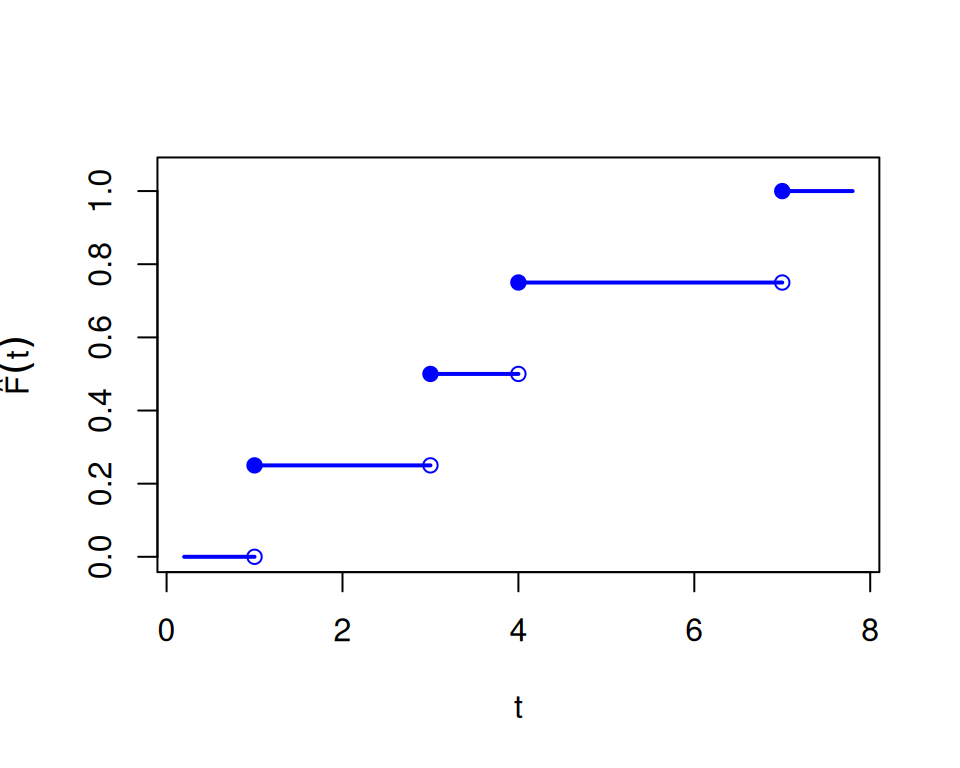
Figure 1: Relationship between the empirical CDF and sample quantiles for data 4, 1, 7, 3. (Order statistics are 1, 3, 4, 7.)
(a) Empirical CDF horizontal pieces only. Closed circles mark included endpoints. Open circles mark excluded endpoints.
(b) Sample quantile function horizontal pieces only. Open circles mark excluded left endpoints. Closed circles mark included right endpoints.
Because both functions are step functions, they are not one-to-one. Flat regions in one function map many inputs to the same output, and jump points in one correspond to intervals in the other. So they are generalized inverses rather than exact two-sided inverses.