Functions from these packages will be used throughout this document:
[R code]
library(conflicted) # check for conflicting function definitions# library(printr) # inserts help-file output into markdown outputlibrary(rmarkdown) # Convert R Markdown documents into a variety of formats.library(pander) # format tables for markdownlibrary(ggplot2) # graphicslibrary(ggfortify) # help with graphicslibrary(dplyr) # manipulate datalibrary(tibble) # `tibble`s extend `data.frame`slibrary(magrittr) # `%>%` and other additional piping toolslibrary(haven) # import Stata fileslibrary(knitr) # format R output for markdownlibrary(tidyr) # Tools to help to create tidy datalibrary(plotly) # interactive graphicslibrary(dobson) # datasets from Dobson and Barnett 2018library(parameters) # format model output tables for markdownlibrary(haven) # import Stata fileslibrary(latex2exp) # use LaTeX in R code (for figures and tables)library(fs) # filesystem path manipulationslibrary(survival) # survival analysislibrary(survminer) # survival analysis graphicslibrary(KMsurv) # datasets from Klein and Moeschbergerlibrary(parameters) # format model output tables forlibrary(webshot2) # convert interactive content to static for pdflibrary(forcats) # functions for categorical variables ("factors")library(stringr) # functions for dealing with stringslibrary(lubridate) # functions for dealing with dates and timeslibrary(broom) # Summarizes key information about statistical objects in tidy tibbleslibrary(broom.helpers) # Provides suite of functions to work with regression model 'broom::tidy()' tibbles
Here are some R settings I use in this document:
[R code]
rm(list =ls()) # delete any data that's already loaded into Rconflicts_prefer(dplyr::filter)ggplot2::theme_set( ggplot2::theme_bw() +# ggplot2::labs(col = "") + ggplot2::theme(legend.position ="bottom",text = ggplot2::element_text(size =12, family ="serif")))knitr::opts_chunk$set(message =FALSE)options('digits'=6)panderOptions("big.mark", ",")pander::panderOptions("table.emphasize.rownames", FALSE)pander::panderOptions("table.split.table", Inf)conflicts_prefer(dplyr::filter) # use the `filter()` function from dplyr() by defaultlegend_text_size =9run_graphs =TRUE
Acknowledgements
This content is adapted from Vittinghoff et al. (2012), Chapter 3.
1 Introduction
This appendix reviews fundamental statistical methods that are prerequisites for the main content of this course. Most of this material should be familiar from Epi 202 and Epi 203.
Example dataset: HERS
Throughout this appendix we use the HERS dataset as a running example.
The “heart and estrogen/progestin study” (HERS) was a clinical trial of hormone therapy for prevention of recurrent heart attacks and death among 2,763 post-menopausal women with existing coronary heart disease (CHD) (Hulley et al. 1998).
The trial was conducted at 20 US clinical centers. Participants were randomized to receive either conjugated equine estrogens (0.625 mg/day) plus medroxyprogesterone acetate (2.5 mg/day) or a matching placebo (Hulley et al. 1998). Women were followed for an average of 4.1 years (Hulley et al. 1998).
The primary outcome was nonfatal myocardial infarction or CHD death (Hulley et al. 1998).
The divisor \(n - 1\) (rather than \(n\)) makes \(s^2\) an unbiased estimator of the population variance \(\sigma^2\).
Sample standard deviation
Definition 3 (Sample standard deviation) The sample standard deviation is \(s = \sqrt{s^2}\). It is expressed in the same units as the original data, making it more interpretable than the variance.
Sample median
Definition 4 (Sample median) The sample median is the middle value when observations are sorted in ascending order. For \(n\) observations:
If \(n\) is odd, the median is the \(\frac{n+1}{2}\)th order statistic.
If \(n\) is even, the median is the average of the \(\frac{n}{2}\)th and \(\frac{n}{2}+1\)th order statistics.
The median is more robust to outliers than the mean.
Interquartile range
Definition 5 (Interquartile range) The interquartile range (IQR) is the difference between the 75th percentile (the third quartile, \(Q_3\)) and the 25th percentile (the first quartile, \(Q_1\)):
\[\text{IQR} = Q_3 - Q_1\]
Like the median, the IQR is robust to outliers.
2.2 Summary statistics for categorical variables
Sample proportion
Definition 6 (Sample proportion) For a binary outcome, the sample proportion of “successes” (coded as 1) is:
\[\hat{p} = \frac{k}{n}\]
where \(k\) is the number of successes and \(n\) is the total sample size.
2.3 Computing summary statistics in R
The tbl_summary() function from the gtsummary package produces formatted summary tables:
Graphical summaries reveal aspects of the data distribution that summary statistics may miss, such as skewness, multimodality, and outliers.
Histograms
A histogram displays the distribution of a continuous variable by dividing the range of values into intervals (bins) and plotting the number or proportion of observations in each bin.
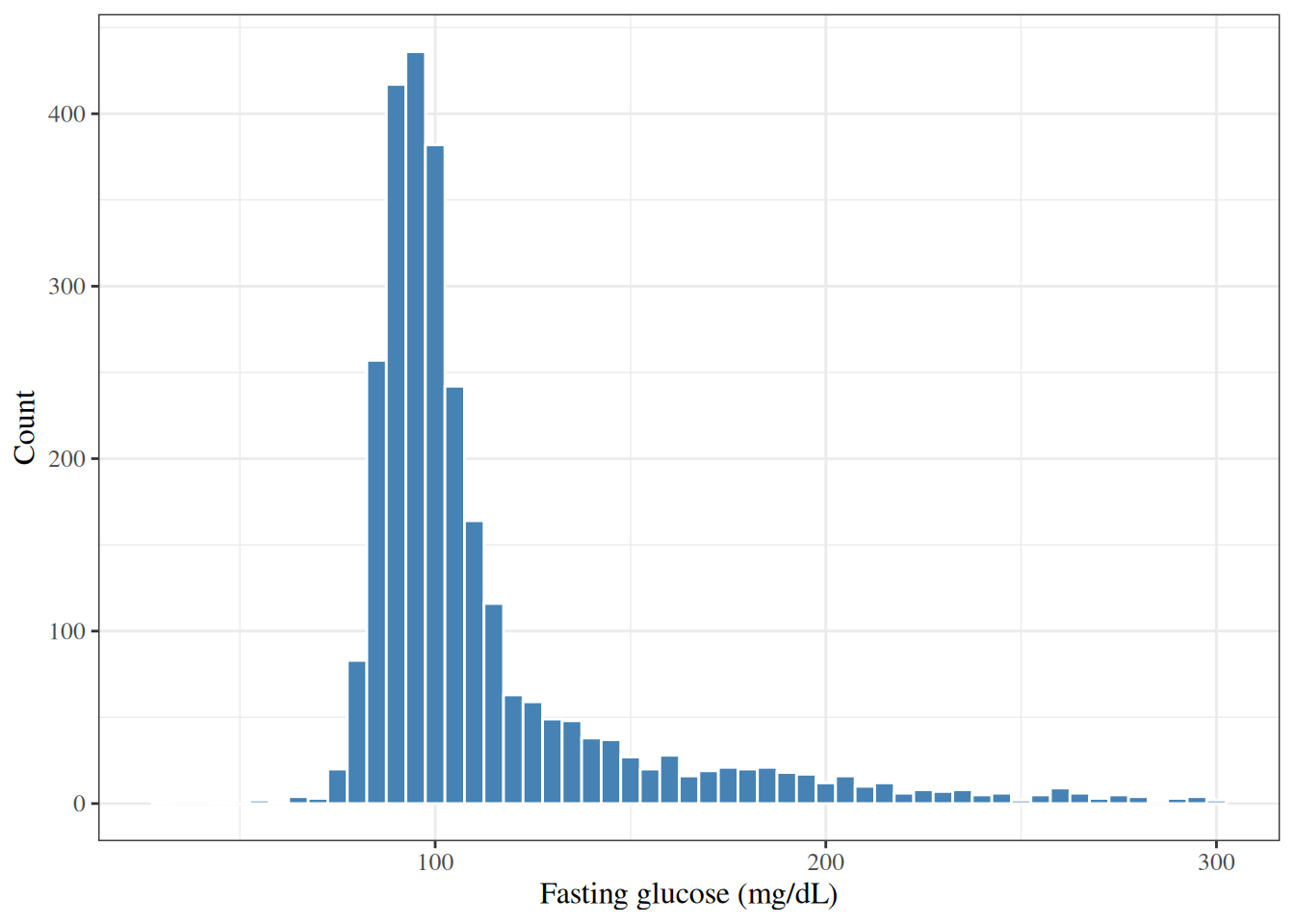
Distribution of fasting glucose
Example 2
library(ggplot2)hers |>ggplot() +aes(x = glucose) +geom_histogram(binwidth =5, fill ="steelblue", color ="white") +labs(x ="Fasting glucose (mg/dL)",y ="Count" )
Figure 1: Distribution of fasting glucose (mg/dL) in HERS participants
Boxplots
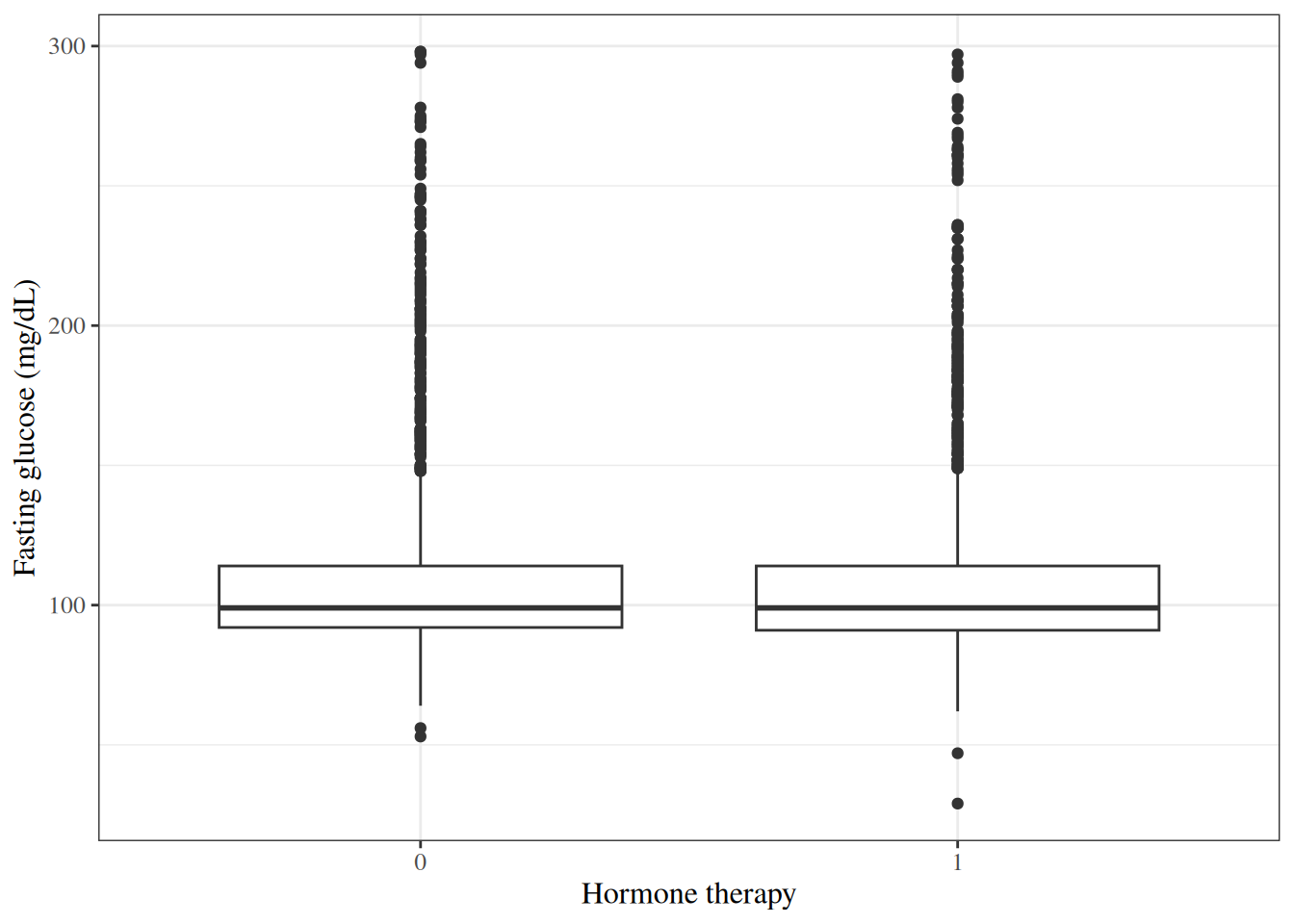
A boxplot (box-and-whisker plot) summarizes the distribution of a continuous variable using five statistics: the minimum, the first quartile (\(Q_1\)), the median, the third quartile (\(Q_3\)), and the maximum (with outliers plotted separately).
Definition 7 (Null hypothesis) The null hypothesis\(H_0\) is a specific claim about the population parameter(s) that we test against the data. In a two-group comparison of means, the null hypothesis is typically that the two group means are equal:
\[H_0: \mu_1 = \mu_2\]
Alternative hypothesis
Definition 8 (Alternative hypothesis) The alternative hypothesis\(H_1\) (or \(H_A\)) is the claim we are trying to find evidence for. For a two-sided test:
\[H_1: \mu_1 \neq \mu_2\]
3.2 The two-sample t-test
Definition
Definition 9 (Two-sample t-test) The two-sample t-test (Welch’s t-test) tests whether the means of two independent groups are equal.
For samples of sizes \(n_1\) and \(n_2\) from two groups with sample means \(\bar{x}_1\), \(\bar{x}_2\) and sample variances \(s_1^2\), \(s_2^2\), the test statistic is:
Under \(H_0\), this statistic follows (approximately) a \(t\)-distribution with degrees of freedom estimated by the Welch-Satterthwaite equation.
Welch’s t-test vs. pooled t-test
Note
Welch’s t-test (the default in R’s t.test()) does not assume equal variances across groups. The pooled t-test assumes equal variances (\(\sigma_1^2 = \sigma_2^2\)) and pools the two sample variances into a single estimate. Welch’s t-test is generally preferred because the equal-variance assumption is rarely verifiable in practice (Vittinghoff et al. 2012, sec. 3.3).
Comparing fasting glucose between hormone therapy groups
Example 5 We test \(H_0: \mu_\text{placebo} = \mu_\text{HT}\) vs. \(H_1: \mu_\text{placebo} \neq \mu_\text{HT}\).
glucose_placebo <- hers |>filter(HT ==0) |>pull(glucose)glucose_HT <- hers |>filter(HT ==1) |>pull(glucose)t.test(glucose_HT, glucose_placebo)#> #> Welch Two Sample t-test#> #> data: glucose_HT and glucose_placebo#> t = -0.4246, df = 2761, p-value = 0.671#> alternative hypothesis: true difference in means is not equal to 0#> 95 percent confidence interval:#> -3.34503 2.15423#> sample estimates:#> mean of x mean of y #> 111.854 112.449
3.3 One-sample t-test
Definition
Definition 10 (One-sample t-test) The one-sample t-test tests whether the mean of a single population equals a specified null value \(\mu_0\):
\[H_0: \mu = \mu_0 \qquad H_1: \mu \neq \mu_0\]
The test statistic is:
\[t = \frac{\bar{x} - \mu_0}{s / \sqrt{n}}\]
Under \(H_0\), \(t \sim t_{n-1}\) (a t-distribution with \(n-1\) degrees of freedom).
3.4 Paired t-test
Definition
Definition 11 (Paired t-test) The paired t-test compares two related measurements (e.g., pre- and post-treatment values from the same subjects). Let \(d_i = x_{i,1} - x_{i,2}\) be the within-subject difference; the test reduces to a one-sample t-test on the differences:
\[H_0: \mu_d = 0 \qquad H_1: \mu_d \neq 0\]
Change in glucose over follow-up
Example 6
# glucose1 is follow-up glucose; glucose is baselinet.test(hers$glucose1, hers$glucose, paired =TRUE)#> #> Paired t-test#> #> data: hers$glucose1 and hers$glucose#> t = 4.151, df = 2612, p-value = 3.42e-05#> alternative hypothesis: true mean difference is not equal to 0#> 95 percent confidence interval:#> 1.38248 3.85824#> sample estimates:#> mean difference #> 2.62036
3.5 Confidence intervals for the difference in means
A two-sided \((1-\alpha) \cdot 100\%\) confidence interval for \(\mu_1 - \mu_2\) is:
where \(t^*_{df}\) is the appropriate critical value from the t-distribution. The confidence interval is returned by t.test() in R alongside the hypothesis test result.
Definition 13 (Contingency table) A contingency table (cross-tabulation) displays the joint frequencies of two categorical variables. For two binary variables, this is a \(2 \times 2\) table with cells \(a\), \(b\), \(c\), \(d\):
Table 2: Exercise by hormone therapy group in HERS
Hormone therapy
Total
0
1
Exercises regularly
0
853 (50%)
842 (50%)
1,695 (100%)
1
530 (50%)
538 (50%)
1,068 (100%)
Total
1,383 (50%)
1,380 (50%)
2,763 (100%)
5.2 The chi-square test
Definition
Definition 14 (Chi-square test) The Pearson chi-square test tests whether two categorical variables are independent. For a \(2 \times 2\) table, the test statistic is:
where \(O_{ij}\) is the observed cell count and \(E_{ij} = \frac{(\text{row total}) \times (\text{column total})}{n}\) is the expected cell count under independence.
Under \(H_0\) (independence), \(\chi^2 \sim \chi^2_1\) for a \(2 \times 2\) table.
Chi-square test: exercise vs. hormone therapy
Example 9
chisq.test(hers$exercise, hers$HT)#> #> Pearson's Chi-squared test with Yates' continuity correction#> #> data: hers$exercise and hers$HT#> X-squared = 0.1016, df = 1, p-value = 0.75
5.3 Fisher’s exact test
Definition
Definition 15 (Fisher’s exact test)Fisher’s exact test computes the exact probability of observing a \(2 \times 2\) table at least as extreme as the observed table, given the marginal totals and under the null hypothesis of independence.
It is preferred over the chi-square test when cell counts are small (typically when any expected cell count is less than 5).
Fisher’s exact test example
Example 10
fisher.test(hers$exercise, hers$HT)#> #> Fisher's Exact Test for Count Data#> #> data: hers$exercise and hers$HT#> p-value = 0.725#> alternative hypothesis: true odds ratio is not equal to 1#> 95 percent confidence interval:#> 0.879664 1.202192#> sample estimates:#> odds ratio #> 1.02836
Definition 16 (Pearson correlation coefficient) The Pearson correlation coefficient measures the strength and direction of the linear association between two continuous variables \(X\) and \(Y\):
\(r\) ranges from \(-1\) (perfect negative linear relationship) to \(+1\) (perfect positive linear relationship); \(r = 0\) indicates no linear association.
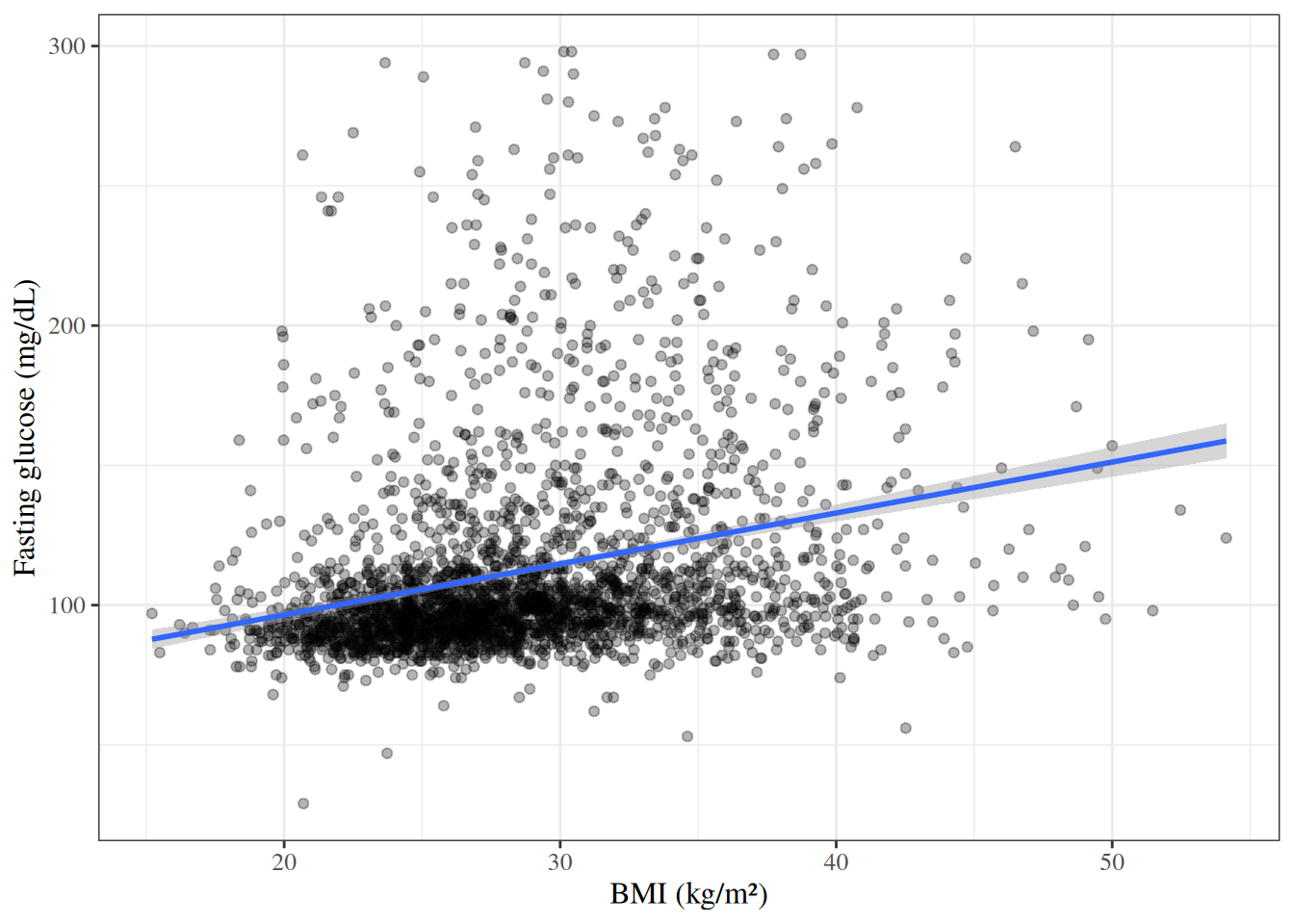
Correlation between BMI and glucose
Example 11
cor.test(hers$BMI, hers$glucose, method ="pearson")#> #> Pearson's product-moment correlation#> #> data: hers$BMI and hers$glucose#> t = 14.88, df = 2756, p-value <2e-16#> alternative hypothesis: true correlation is not equal to 0#> 95 percent confidence interval:#> 0.237760 0.306865#> sample estimates:#> cor #> 0.272664
6.2 Spearman rank correlation
Definition
Definition 17 (Spearman rank correlation) The Spearman rank correlation\(r_S\) is the Pearson correlation computed on the ranks of the observations. It measures the strength and direction of any monotone association (not just linear) and is more robust to outliers.
Spearman correlation between BMI and glucose
Example 12
cor.test(hers$BMI, hers$glucose, method ="spearman")#> #> Spearman's rank correlation rho#> #> data: hers$BMI and hers$glucose#> S = 2.33e+09, p-value <2e-16#> alternative hypothesis: true rho is not equal to 0#> sample estimates:#> rho #> 0.333751
where \(r\) is the Pearson correlation and \(s_x\), \(s_y\) are the sample standard deviations.
7.3 Fitting a simple linear regression in R
Glucose on BMI
Example 13
Table 3
slr_fit <-lm(glucose ~ BMI, data = hers)summary(slr_fit)#> #> Call:#> lm(formula = glucose ~ BMI, data = hers)#> #> Residuals:#> Min 1Q Median 3Q Max #> -81.55 -18.98 -10.35 3.76 190.81 #> #> Coefficients:#> Estimate Std. Error t value Pr(>|t|) #> (Intercept) 60.074 3.565 16.9 <2e-16 ***#> BMI 1.822 0.122 14.9 <2e-16 ***#> ---#> Signif. codes: 0 '***' 0.001 '**' 0.01 '*' 0.05 '.' 0.1 ' ' 1#> #> Residual standard error: 35.5 on 2756 degrees of freedom#> (5 observations deleted due to missingness)#> Multiple R-squared: 0.0743, Adjusted R-squared: 0.074 #> F-statistic: 221 on 1 and 2756 DF, p-value: <2e-16
The estimated slope is \(\hat\beta_1 = 1.82\) mg/dL per kg/m², meaning fasting glucose increases by approximately 1.82 mg/dL for each 1 kg/m² increase in BMI.
7.4 The coefficient of determination (\(R^2\))
Definition
Definition 19 (Coefficient of determination (\(R^2\))) The coefficient of determination\(R^2\) measures the proportion of the total variance in \(Y\) that is explained by the linear regression on \(X\):
\(R^2\) ranges from 0 (no linear relationship) to 1 (perfect linear fit). For simple linear regression, \(R^2 = r^2\).
7.5 Further reading
For a more thorough treatment of linear regression, see Linear Models Overview and Vittinghoff et al. (2012), Chapters 4 and 9.
8 Bootstrap Confidence Intervals
8.1 When to use the bootstrap
Bootstrapping is a widely applicable method for obtaining standard errors and CIs in three situations:
Approximate methods for computing valid CIs have been developed but are not conveniently implemented in standard software.
Developing closed-form approximate methods has turned out to be intractable.
The dataset violates the assumptions underlying established methods badly enough that the resulting CIs would be unreliable.
8.2 The bootstrap procedure
Definition 20 (Bootstrap sample) A bootstrap sample is a sample of size \(n\) drawn with replacement from the observed data of size \(n\). Because sampling is with replacement, each bootstrap sample contains some observations more than once and omits others entirely.
Example 14 (Bootstrap sample) Consider a dataset of five observations: \(\{3,\;7,\;5,\;2,\;9\}\) (\(n = 5\)). Two possible bootstrap samples drawn with replacement are:
Bootstrap sample
Values drawn
Notes
1
\(3,\;3,\;7,\;5,\;9\)
3 appears twice; 2 not drawn
2
\(2,\;7,\;7,\;9,\;5\)
7 appears twice; 3 not drawn
Each sample has size \(n = 5\) but may repeat or omit individual observations from the original dataset.
Definition 21 (Bootstrap distribution) The bootstrap distribution of a statistic is the empirical distribution of that statistic computed across a large number \(B\) of bootstrap samples. It serves as an estimate of the sampling distribution of the statistic. The bootstrap standard error is the standard deviation of the bootstrap distribution.
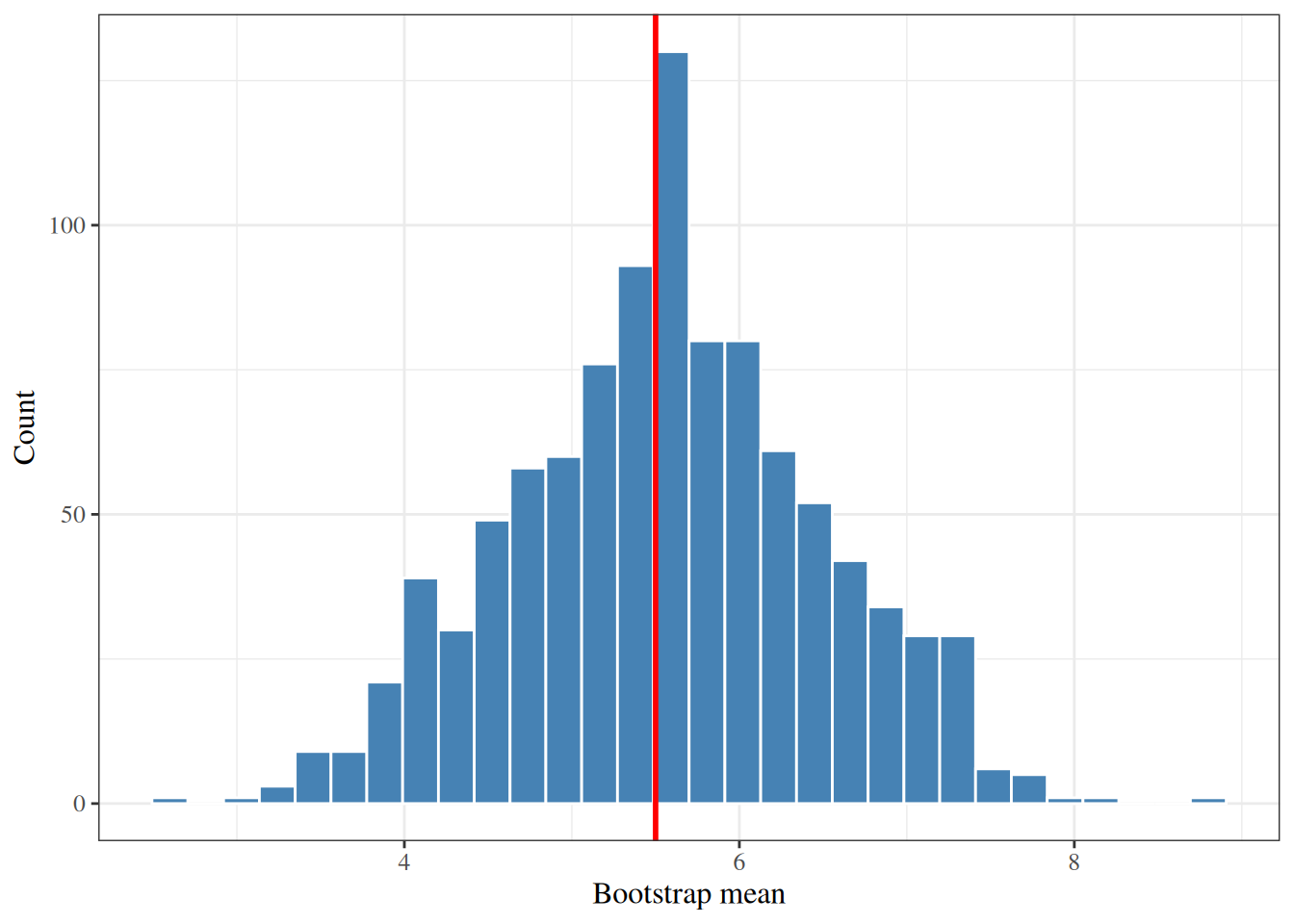
Using the 10-observation dataset \(\mathopen{}\left\{3, 7, 5, 2, 9, 4, 8, 1, 6, 10\right\}\mathclose{}\) (observed mean 5.5), we draw \(B = 1{,}000\) bootstrap resamples and compute the sample mean of each. The bootstrap distribution is centered near the observed mean with bootstrap standard error 0.92.
[R code]
library(ggplot2)ggplot(data.frame(mean = boot_means_toy)) +aes(x = mean) +geom_histogram(bins =30, color ="white", fill ="steelblue") +geom_vline(xintercept =mean(toy), color ="red", linewidth =1) +labs(x ="Bootstrap mean", y ="Count")
Figure 4: Bootstrap distribution of the sample mean (\(B = 1{,}000\) replicates, \(n = 10\) toy dataset). The red line marks the observed mean (5.5). The distribution is approximately normal and centered near \(\bar{x}\).
The key idea is to treat the observed sample as a stand-in for the source population, and to mimic repeated sampling from that population by resampling with replacement from the observed data.
If the bootstrap distribution of the statistic of interest is approximately normal, replace the model-based standard error in a conventional CI with the bootstrap standard deviation:
This method requires fewer bootstrap replicates than percentile-based methods, but is less reliable when the sampling distribution departs from normality, particularly in the tails.
Example 16 (Normal approximation) Continuing from Example 15: the observed mean is 5.5 and the bootstrap standard error is 0.92. The 95% normal-approximation CI is:
The CI is constructed from the empirical quantiles of the bootstrap distribution. A 95% CI spans the 2.5th to 97.5th percentiles of the \(B\) bootstrap estimates.
Because the extreme percentiles of a finite sample are noisy estimates of the corresponding population quantiles, a larger number of replicates is required (typically \(B \geq 1{,}000\)).
Example 17 (Percentile method) Continuing from Example 15 with \(B = 1{,}000\) bootstrap means: the 2.5th percentile is 3.8 and the 97.5th percentile is 7.3, giving a 95% CI of (3.8, 7.3).
Bias-corrected and accelerated (BCa) method
The BCa interval adjusts the percentile-based CI to account for both bias (a shift between the observed statistic and the median of the bootstrap distribution) and skewness in the bootstrap distribution (James et al. 2021, chap. 5, p. 209). BCa intervals are preferred when the bootstrap distribution is noticeably skewed.
Example 18 (Bias-corrected and accelerated method) The BCa interval for the toy dataset is computed automatically by boot.ci() in R, which handles the bias-correction and acceleration adjustments internally. The comprehensive worked example below demonstrates all three CI methods side by side, making it straightforward to compare the BCa interval to the normal and percentile intervals.
8.4 Bootstrap CI in R
The boot package (included with base R) provides boot() for resampling and boot.ci() for all three CI types.
Bootstrap CI for the slope of SBP on age
Example 19 We adapt the example from (Vittinghoff et al. 2012, sec. 3.6, p. 62): a simple linear regression of systolic blood pressure (SBP) on age in the HERS dataset.
[R code]
library(boot)# statistic function: returns the slope of SBP ~ ageboot_slope <-function(data, indices) { fit <-lm(SBP ~ age, data = data[indices, ])coef(fit)[["age"]]}set.seed(42)boot_result <-boot(data = hers,statistic = boot_slope,R =1000)boot_result#> #> ORDINARY NONPARAMETRIC BOOTSTRAP#> #> #> Call:#> boot(data = hers, statistic = boot_slope, R = 1000)#> #> #> Bootstrap Statistics :#> original bias std. error#> t1* 0.471728 -0.000635537 0.0536514
The bootstrap standard error closely matches the model-based standard error from lm(). All three bootstrap intervals below are consistent with the parametric CI.
[R code]
boot.ci( boot_result,type =c("norm", "perc", "bca"))#> BOOTSTRAP CONFIDENCE INTERVAL CALCULATIONS#> Based on 1000 bootstrap replicates#> #> CALL : #> boot.ci(boot.out = boot_result, type = c("norm", "perc", "bca"))#> #> Intervals : #> Level Normal Percentile BCa #> 95% ( 0.3672, 0.5775 ) ( 0.3607, 0.5811 ) ( 0.3624, 0.5824 ) #> Calculations and Intervals on Original Scale
The normal, percentile, and BCa intervals are all similar here, consistent with the bootstrap distribution being approximately symmetric. In cases with more skewness, the BCa interval would differ more from the others, and should be preferred.
Hulley, Stephen, Deborah Grady, Trudy Bush, et al. 1998. “Randomized Trial of Estrogen Plus Progestin for Secondary Prevention of Coronary Heart Disease in Postmenopausal Women.”JAMA : The Journal of the American Medical Association (Chicago, IL) 280 (7): 605–13.
James, Gareth, Daniela Witten, Trevor Hastie, and Robert Tibshirani. 2021. An Introduction to Statistical Learning: With Applications in R. 2nd ed. Springer. https://doi.org/10.1007/978-1-0716-1418-1.
Vittinghoff, Eric, David V Glidden, Stephen C Shiboski, and Charles E McCulloch. 2012. Regression Methods in Biostatistics: Linear, Logistic, Survival, and Repeated Measures Models. 2nd ed. Springer. https://doi.org/10.1007/978-1-4614-1353-0.