Quarto Vignette Example
1 Introduction
This vignette demonstrates how to use Quarto (.qmd) files as vignettes in R packages. Quarto is the next-generation version of R Markdown, offering enhanced features and better integration with multiple programming languages.
2 Why Use Quarto?
Quarto offers several advantages over traditional R Markdown:
- Enhanced features: Better support for cross-references, callouts, and other advanced formatting
- Multiple engines: Works with R, Python, Julia, and Observable
- Modern syntax: Cleaner YAML and chunk options using
#|syntax - Better publishing: Improved website and book publishing capabilities
3 Basic Example
Here’s a basic example using the package:
4 Quarto Features
Callouts
Note
This is a callout block that highlights important information.
Tip
Quarto supports multiple types of callouts: note, tip, warning, important, and caution.
Code Chunks with Modern Syntax
You can use the modern #| syntax for chunk options:
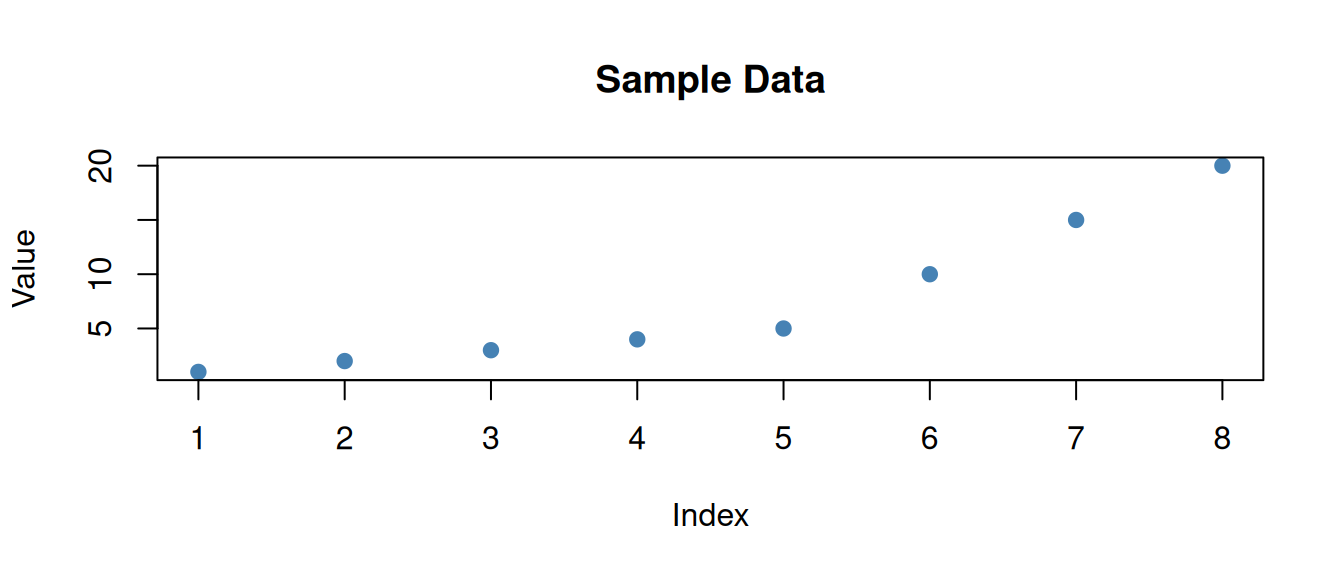
Figure 1: Example plot showing data distribution
5 Theorem Environments
Quarto supports theorem and proof environments that integrate with the callouty-theorem extension to render as styled callout blocks.
Definition 1 (Sample Mean) The sample mean of observations \(x_1, x_2, \ldots, x_n\) is:
\[\bar{x} = \frac{1}{n}\sum_{i=1}^{n} x_i\]
Theorem 1 (Unbiasedness of the Sample Mean) The sample mean \(\bar{x}\) is an unbiased estimator of the population mean \(\mu\):
\[E[\bar{x}] = \mu\]
Proof
Proof. By linearity of expectation: \[E[\bar{x}] = E\!\left[\frac{1}{n}\sum_{i=1}^{n} x_i\right] = \frac{1}{n}\sum_{i=1}^{n} E[x_i] = \frac{1}{n} \cdot n\mu = \mu. \qquad \square\]
Example 1 (Computing the Sample Mean) For the data \(\{1, 2, 3, 4, 5\}\): \[\bar{x} = \frac{1+2+3+4+5}{5} = 3\]
6 Equations
Quarto has excellent support for mathematical equations using LaTeX syntax:
Inline equation: \(E = mc^2\)
Display equation:
\[ \bar{x} = \frac{1}{n}\sum_{i=1}^{n} x_i \]
7 Tables
| Feature | R Markdown | Quarto |
|---|---|---|
| YAML | Standard | Enhanced |
| Chunks | {r, option=value} |
#| option: value |
| Publishing | Good | Excellent |
| Cross-refs | Limited | Native |
8 Summary
Quarto vignettes provide a modern, feature-rich way to document R packages. They integrate seamlessly with documentation systems and offer enhanced capabilities for technical documentation.
9 References
For more information, see:
- Quarto Documentation
- Using Quarto with R
- R Core Team (2024)
- UCD-SERG (2024)